

Something is shifting—and if you’ve spent any real time in this business, you can feel it.
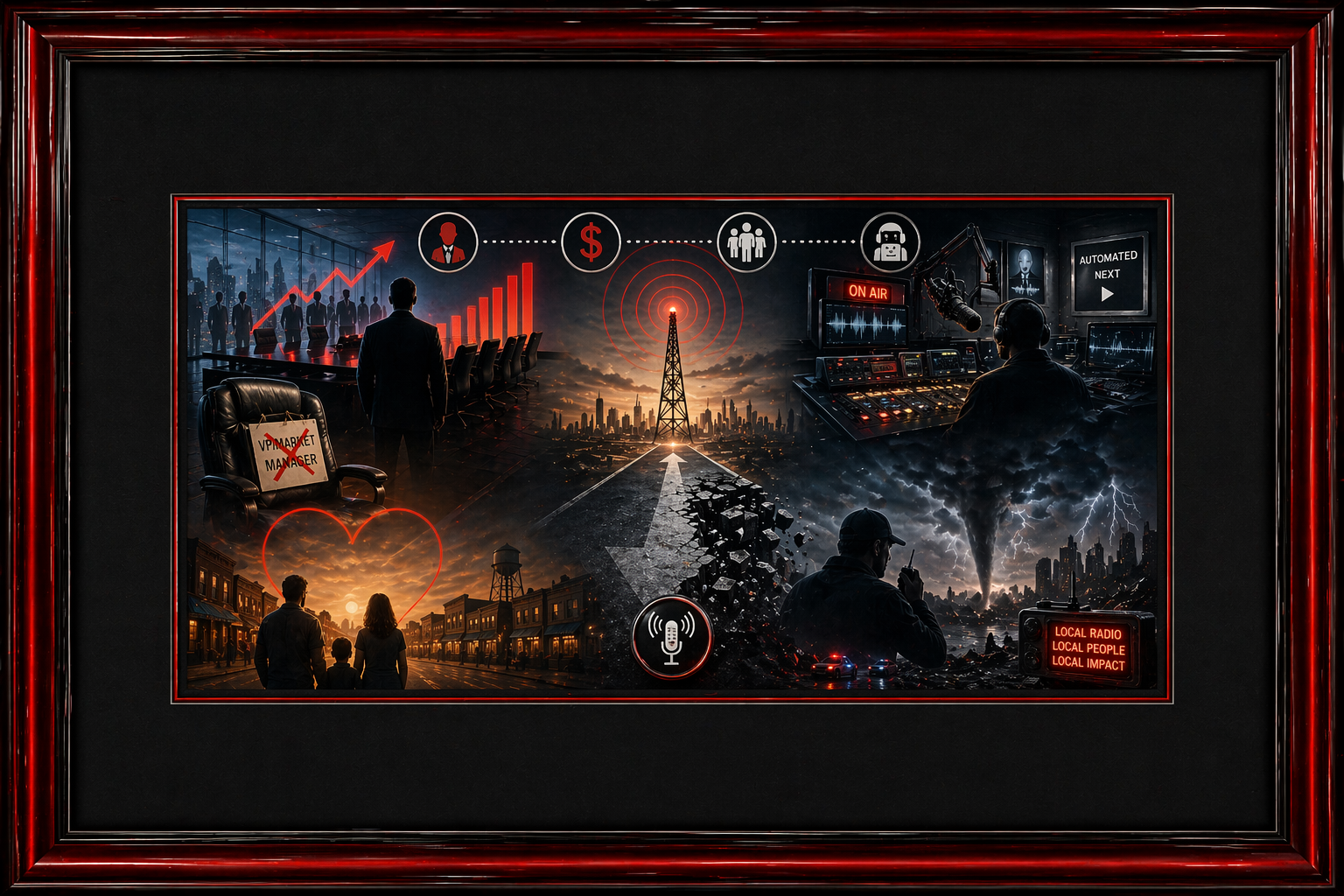
Across multiple broadcast companies, we’re watching leadership structures change in a very specific direction. VP and Market Manager roles are being reduced, redefined, or replaced. In their place, we’re seeing more Senior Vice President of Sales roles—more revenue-driven leadership at the top of the building.
On paper, it makes sense.
Revenue is under pressure. Competition is everywhere. Digital continues to pull audience and dollars in new directions. If the challenge is financial, then you elevate the people responsible for driving revenue. You streamline structure. You remove layers. You build something leaner.
That’s the logic.
But radio has never been just about logic.
I’ve been in this business for 32 years. I’ve sat in programming chairs, leadership roles, and watched this industry evolve through consolidation, technology shifts, and format wars.
I have never seen anything quite like this.
Not this fast.
Not this widespread.
Not this focused on one side of the business.
Because when you shift leadership almost entirely toward sales, something else inevitably changes—and that something is local presence.
You can already see where this is going.
Fewer local programmers.
More regional oversight.
Clusters guided from a distance instead of from inside the building.
And eventually? It’s not hard to imagine a structure where a station has one primary talent—maybe mornings—and the rest of the day is filled with automation or voice tracking. One programmer overseeing multiple markets. No local Program Director. No local VP of Programming.
Again, on paper, it works.
Lower cost.
Consistent sound.
Predictable execution.
But radio has never been at its best when it’s predictable.
Radio is at its best when it’s present.
When something happens in a community, radio doesn’t wait. It reacts. It leads. It informs. It connects.
So here’s the question that doesn’t show up in a spreadsheet:
What happens when that local presence isn’t there?
When a tornado touches down.
When a hurricane changes direction.
When a wildfire spreads faster than expected.
When something real—something urgent—happens in a community that needs information right now.
Who’s there?
Not just on the air.
In the building.
In the market.
In the moment.
Because being local has never just meant having a signal in the area.
It means having people who know the area.
People who can pivot without waiting for direction.
People who understand the streets, the neighborhoods, the heartbeat of the community.
That’s what built radio.
And right now, that’s the piece that feels like it’s being tested.
To be clear, the pressures driving these decisions are real. Companies are adapting to survive. Costs have to be managed. Revenue has to grow. The industry is responding the way industries do.
There is logic behind the moves being made.
But there is also a long-term cost that doesn’t show up immediately.
It shows up in connection.
In trust.
In relevance.
Because over time, if a station sounds less local, feels less local, and responds less like it’s part of the community… the audience notices.
Maybe not right away.
But eventually.
Radio has always been a long game. Built on relationships, familiarity, and trust. Built on the idea that when you turn it on, someone is there with you—not just talking, but understanding.
So the question isn’t whether the industry can become more efficient.
It can.
The question is what happens if, in the process, it becomes less present.
Are we ready for that?
Are we prepared for what radio looks like if local becomes optional instead of essential?
Those aren’t dramatic questions.
They’re real ones.
Because the choices being made right now—about leadership, structure, and how stations operate—are going to define what this business looks like for years to come.
Radio has always found a way to adapt.
The hope is that, as it does, it holds on to the part of itself that made it matter in the first place.
On The Dial covers breaking radio industry news, including layoffs, programming changes, talent moves, and broadcast trends across the United States.