

There’s a moment happening in radio right now that doesn’t come with an announcement.
No press release. No panel discussion. No executive stepping up to a microphone to explain it.
It’s just… there.
You feel it before you can fully define it.
The music is still playing. The signals are still strong. The brands are still alive. But underneath all of that—beneath the imaging, beneath the strategy decks, beneath the carefully worded optimism—something fundamental has shifted.
The center of gravity in this industry has moved.
And most people are still looking in the wrong direction.
Because while attention continues to orbit around personalities and leadership titles, the real power inside broadcast radio has been quietly consolidating somewhere else entirely.
Not at the top.
Not on the air.
But in the middle—where the work actually gets done.
The Operator Class.
Not personalities.
Not executives.
Operators.
The ones who didn’t leave when the cuts came through.
The ones who didn’t panic when the structure changed.
The ones who didn’t need permission to figure it out.
They just… did.
They are the ones running multiple stations without needing multiple introductions. The ones making decisions that shape sound, pacing, tone, and identity—without waiting for a meeting to validate it. The ones who understand that radio is no longer maintained by departments… it is maintained by capability.
And capability has become concentrated.
What used to take layers now takes instinct.
What used to require committees now requires clarity.
What used to be delegated is now absorbed.
And the people doing that absorbing? They are not asking for recognition. They are not campaigning for titles. They are not trying to be seen.
They are trying to keep the product from slipping.
Quietly.
Consistently.
Relentlessly.
Because here is the truth that is starting to settle in across markets, clusters, and companies—whether it is being said out loud or not:
Radio didn’t get smaller.
It got tighter.
The excess was stripped away.
The redundancies disappeared.
The margin for error collapsed.
And in that environment, the only thing that matters is execution.
Not theory.
Not hierarchy.
Execution.
That is where the Operator Class lives.
They are the ones who know what a station sounds like at 2:17 in the afternoon when something breaks. They are the ones who can hear a transition and know whether it holds or falls apart. They are the ones who can look at a log, a clock, a lineup—and immediately understand where the energy is and where it’s missing.
They don’t guess.
They adjust.
In real time.
And what makes this shift even more profound is that it didn’t happen because the industry planned it this way.
It happened because it had to.
Years of consolidation. Years of budget tightening. Years of asking fewer people to do more work with higher expectations and less room to fail.
At some point, something had to give.
But instead of collapsing, something else emerged.
A new kind of professional.
Less defined by title.
More defined by function.
Less concerned with recognition.
More focused on results.
The Operator Class.
And if you’re walking through conversations this weekend—whether on a convention floor, in a hotel lobby, or across a late-night table—you can hear it if you’re paying attention.
Not directly.
But in the language.
In the way people talk about “who’s really running things.”
In the quiet respect given to certain names—not because of position, but because of reliability.
In the acknowledgment, sometimes subtle, sometimes blunt, that the people keeping stations competitive right now are not always the ones with the biggest platforms.
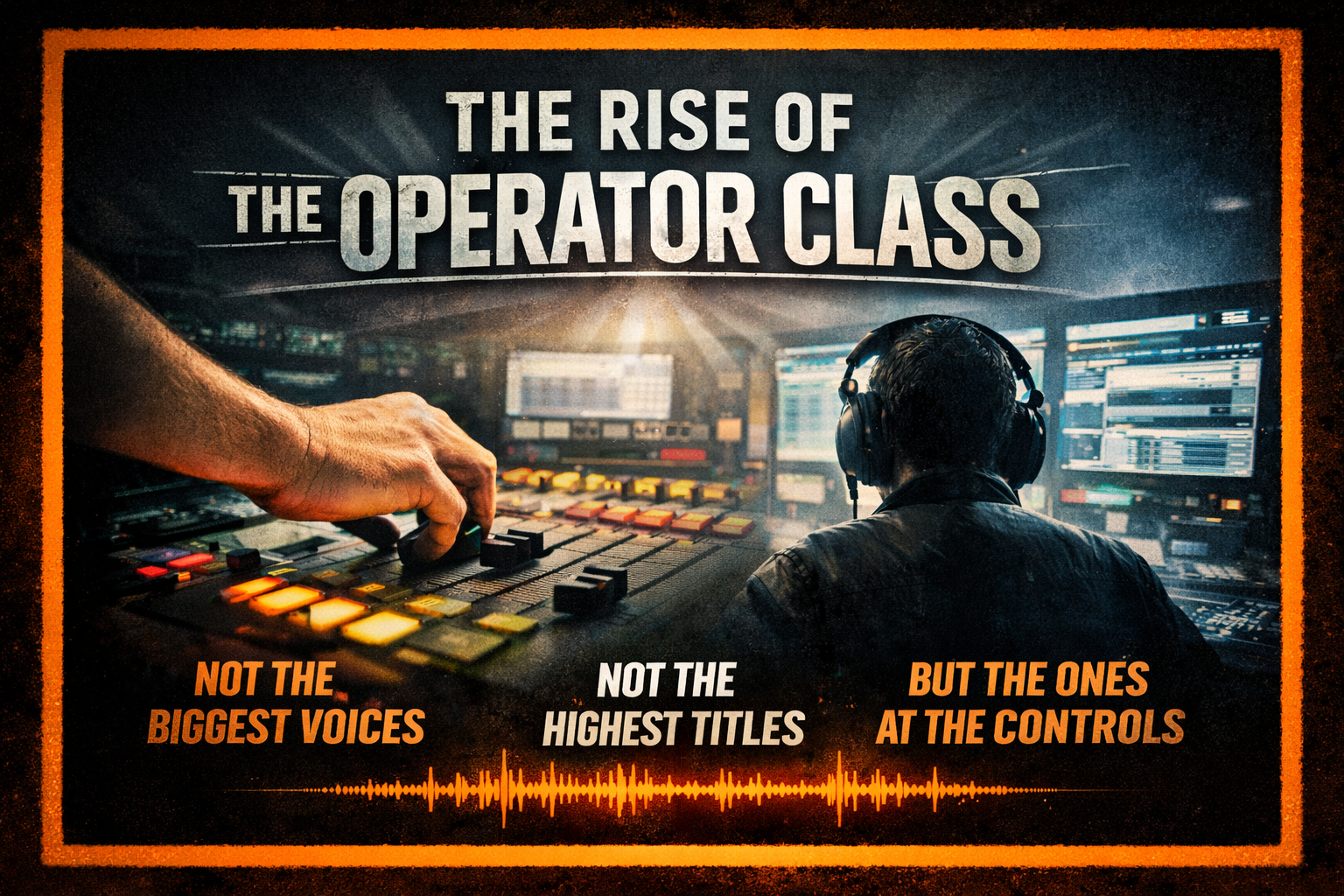
They are the ones closest to the controls.
And that proximity matters more than it ever has.
Because while the industry continues to experiment with automation, AI, and scalable content systems, one reality continues to assert itself:
Tools don’t make decisions.
People do.
And the people making those decisions—minute by minute, hour by hour, day by day—are the operators.
They are the last filter before something goes on the air.
The last line between intentional programming and passive output.
The last defense against a station sounding like it’s been left unattended.
That responsibility used to be shared.
Now, more often than not, it is concentrated.
And with that concentration comes influence.
Real influence.
The kind that doesn’t need to be announced because it is already being felt.
Which raises a question that this industry is going to have to answer sooner rather than later:
What happens when the people doing the most critical work are not the ones the system was originally designed to elevate?
Because that is where this is headed.
The Operator Class is not waiting for permission to matter.
They already do.
The only question is whether the structure around them evolves to reflect that—or continues to operate as if the old model is still intact.
Because it isn’t.
Not anymore.
Radio didn’t disappear.
It recalibrated.
It tightened.
It focused.
And in doing so, it handed the keys—not to the loudest voices, not to the highest titles—but to the ones who never left the controls.
And if you’re really paying attention right now, you don’t need a panel, a keynote, or a headline to tell you that.
You can hear it.
Every time a station still sounds like someone cares.
-WW