


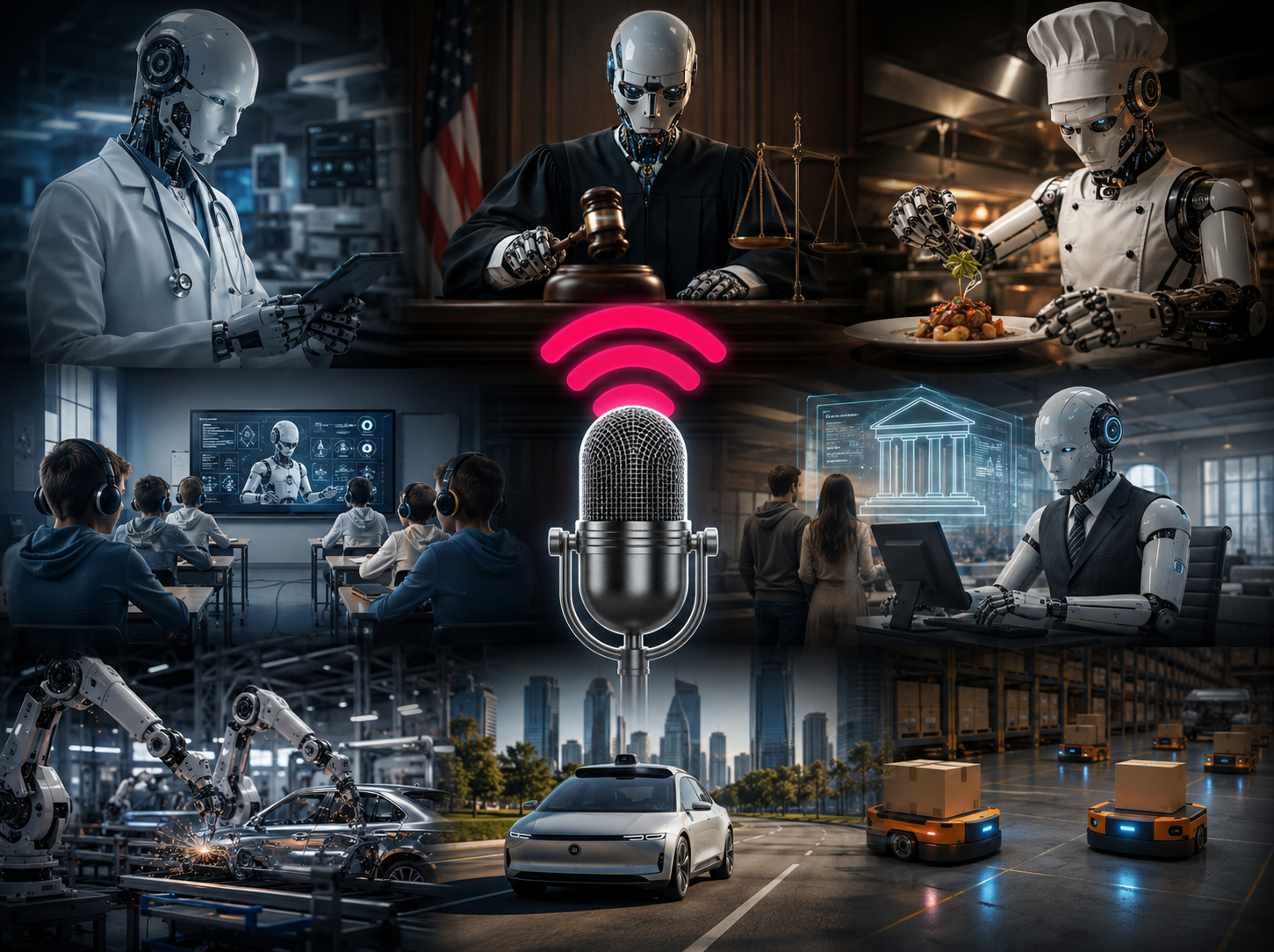
Before You Read This… Suspend Reality For Five Minutes.
Radio people have been living through a fascinating experiment.
Every year, another station automates another shift.
Another market centralizes another department.
Another personality disappears.
The explanation is almost always the same.
It’s more efficient.
That got me thinking.
What if every profession in America adopted the exact same philosophy?
Not just radio.
Everything.
Imagine walking into your favorite restaurant.
There isn’t a host.
There isn’t a waiter.
There isn’t a chef.
An automated system already knows what you’ll order because you ordered it three months ago.
It arrives in exactly four minutes.
Perfectly timed.
Perfectly measured.
Perfectly… forgettable.
Now let’s visit the hospital.
You don’t meet a doctor.
You stand in front of a scanner.
Thirty seconds later a screen lights up.
Diagnosis complete.
Treatment selected.
Prescription transmitted.
Questions are unavailable at this time.
Need a second opinion?
The second computer reaches the exact same conclusion because it was trained on the same database.
Next patient.
Let’s stop by City Hall.
The mayor no longer exists.
A municipal optimization engine decides where roads are repaired…
Which parks stay open…
How police resources are allocated…
Which neighborhoods receive improvements…
No town hall meetings.
No debates.
No elections.
Just percentages.
Now imagine the courtroom.
There are no judges.
No jury.
No witnesses explaining context.
Every arrest is uploaded.
Every piece of evidence scanned.
An automated judicial engine compares your case to twenty million previous rulings.
Verdict.
Sentence.
Appeal denied.
Completed in under two minutes.
No delays.
No backlog.
No discretion.
No mercy.
Because mercy can’t be calculated.
Now let’s go to school.
Teachers don’t exist.
Every student wears a headset.
Lessons automatically adjust to test scores.
Questions are answered instantly.
Nobody notices the quiet kid sitting in the back who’s having the worst week of his life.
The software only tracks grades.
Now let’s buy a house.
No Realtor.
No negotiations.
No conversations.
An algorithm decides what you’re allowed to pay based on your predicted future income.
Offer rejected.
Not because the seller said no.
Because the system says you’ll probably move in six years.
Let’s try getting a loan.
Denied.
No banker explains why.
No one reviews your circumstances.
The predictive model already determined your financial future.
Decision finalized.
Insurance?
Your premium doubles because software predicts you’ll probably develop a medical condition in eleven years.
Not because you have it.
Because statistically…
You might.
Even sports change.
No coaches.
Algorithms determine every play.
Every substitution.
Every timeout.
Every draft pick.
Every contract.
Fans don’t cheer.
They simply wait for the next probability update.
Hollywood?
No writers.
Streaming services already know exactly what movie you’ll watch next.
Every film looks different…
Yet somehow feels exactly the same.
Politics?
Candidates become unnecessary.
An optimization engine simply determines the most statistically acceptable policy for the largest number of people.
Debates disappear.
Campaigns disappear.
Votes disappear.
Efficiency wins.
Then comes radio.
The final frontier.
No DJs.
No producers.
No promotions department.
No local news.
No community calendar.
No school closings.
No lost dog announcements.
No telethons.
No personalities arguing over whether pineapple belongs on pizza.
Every station sounds…
Fine.
Technically flawless.
Predictably perfect.
Entirely interchangeable.
Here’s the twist.
None of these systems fail.
They’re actually incredible.
They’re faster.
Cheaper.
More accurate.
More consistent.
More profitable.
So here’s the uncomfortable question.
At what point does maximum efficiency become too expensive?
Because eventually…
You aren’t replacing jobs.
You’re replacing perspective.
You’re replacing instinct.
You’re replacing experience.
You’re replacing the unpredictable moments that have always pushed industries forward.
Radio people understand this better than anyone.
Not because radio is special.
Because radio was simply one of the first industries forced to answer a question every profession may eventually face.
Just because something can be automated… should it be?
That’s not really a radio question.
That’s becoming everyone’s question.
#Radio #Broadcasting #Automation #FutureOfWork #Leadership #Media #Innovation #Business #Technology #OnTheDial #JustPlainSteve