


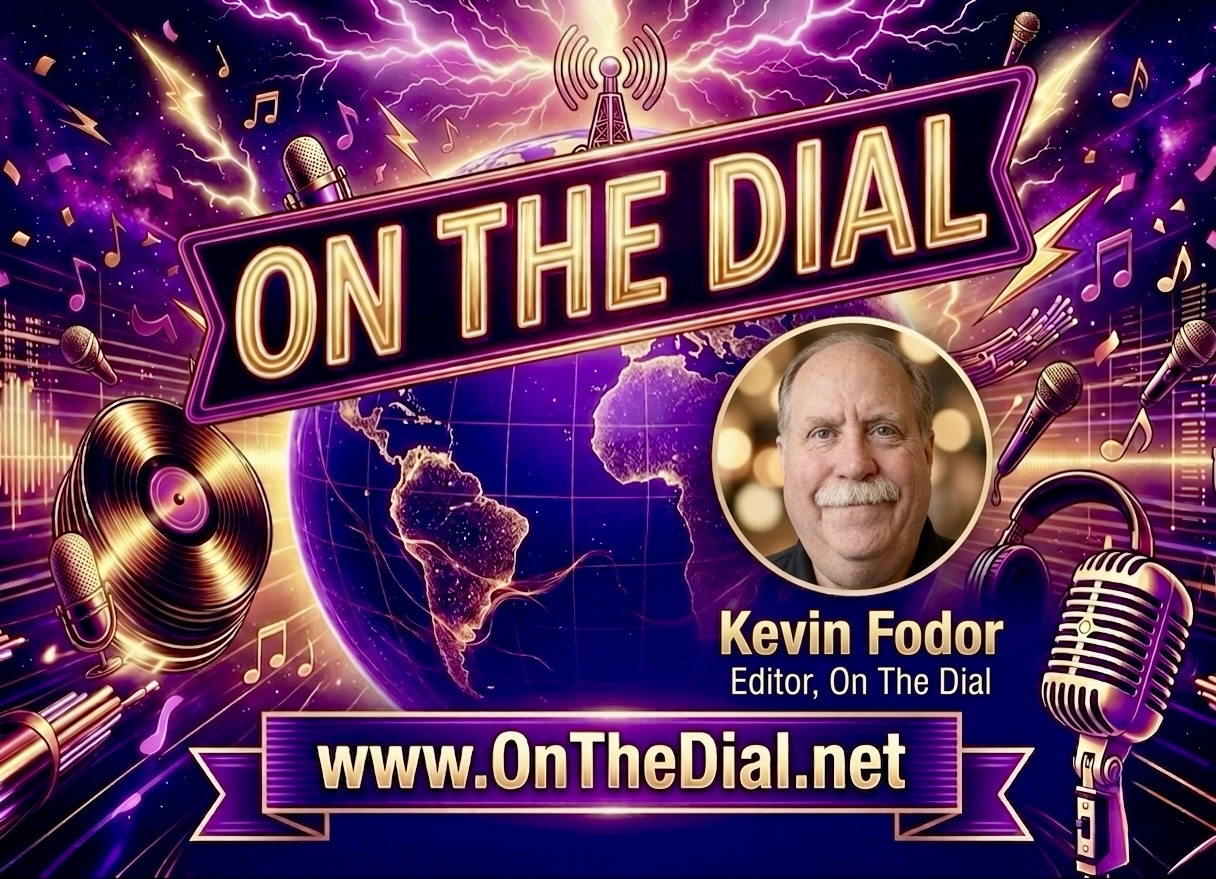
I have been fortunate to have seen the highs and lows of this business called “radio” professionally since October of 1974. Before that, though, I had helped to build an FM station at my high school (WRSF-FM, 89.7 mhz) and had also been on the air at Dayton’s WAVI-AM, 1210 in their Junior Achievement company as far back as 1971. So, all in all, I’ve been on radio for about 56 years total.
Not all of that was in Dayton. I also worked as a News Director in Cincinnati, a jock and APD for Brewer Broadcasting in Richmond, Indiana, a jock and music director on WING-AM in Dayton, a jock, APD and Program Director in Columbus, and as a PD for Saga Communications in Urbana-Champaign, Illinois before returning home to Dayton to work in various capacities (APD/News Anchor/On Air Talent) for my current station group in 2004. I went into a semi-retirement by my request in January 2025.
What changes I have seen! And not all of them for the good.
My first job in Dayton was for Group One Broadcasting of Akron, Ohio at WONE-AM and WTUE-FM in 1976. Both stations were doing quite well back then. WTUE (then a new AOR entry into the market), with WONE a successful Country station (since 1969). Typically, both stations were top 5. Top of the rate card in morning drive was $275 per 60 second spot. I was a weekend and swing shift News Anchor in a News Department with about 8 full and part-time anchors and reporters. I also did afternoon traffic reports from the station’s “news car”, outfitted with a 2 way radio transceiver.
Two years later, I was across town anchoring morning drive news at WAVI-AM and WDAO-FM. I was there about a year before the station engineer (who also did contact work with other companies) got me into WCIN-AM in Cincinnati as News Director. Suddenly, at age 23, I was running a radio newsroom in market 25! The then Radio-Television News Director’s Association named me the “youngest” large market radio news director in the United States!
But then, the FCC came along and made a new rule. It eliminated an old one that said a radio station had to “pledge” a percentage of the program week to news and public affairs.
It occurred to me at that point that this would lead to radio news jobs being eliminated and so my next job was spinning records back at home at a station near Dayton in Xenia, Ohio. Slowly, but surely, I watched as AM stations and their FM’s began to “consolidate” news jobs. 10 person staffs became 8, then 5, then 3 and sometimes 1.
Why? Someone decided that since having a full “news department” was no longer necessary, cost savings could be made by eliminating news jobs.
So, if you think consolidation began with the 1996 Telecommunications Act, you couldn’t be more incorrect.
Then came another new idea by Uncle Charlie (aka the FCC). It was called “Docket 80/90”. First discussed in the later years of the Carter Administration, it was passed and accelerated under the Reagan Administration.
The idea was to create additional radio stations on the FM band in an attempt to improve minority ownership of radio stations. Did it? History shows for a time, the answer was yes. But over time, many of those stations were sold to other ownership concerns. So its overall impact on minority ownership lessened as years went by. Some people still debate its success today.
In time, I began to notice something. As station totals increased, station commercial rates slowly decreased.
In 1987, the so-called “Fairness Doctrine” was repealed. It ultimately changed the talk radio format. Many critics say it allowed only one political side to be represented. And though that DID happen, it changed talk in another way.
When I was at WAVI, the station had a morning host who was a Libertarian, a mid-day host who was decidedly Liberal, an afternoon host who was Conservative and until signoff, the evening host could be any political persuasion. The station played music on the weekends, and the talk during the week was local topics and even discussions about how to cook a good steak, and what constituted a fine wine.
It wasn’t all political. But over the years, that’s what it became.
You can’t argue with the success, but in that success I would suggest something got lost in the shuffle. Entertainment. Just listen to hosts as the time went on. Some, though not all lost “entertainment value” and went to pure politics all the time.
And with added syndication and cut backs on the news side, many stations became less local sounding. Over time, the AM audiences began to drop, and those commercial rates continued in decline. All the while, the FCC was now adding stations to the roster by thousands from Docket 80/90 to 1996 Telecom. .
By 1990, many smaller AM stations were being run by computers with the main staff focus on the FM side. But, over time, (and a national recession or two), individual “mom and pop” stations had owners getting up in years and many wanted to sell their stations while they could.
As this happened, the computers got better. The first ones crashed often and needed reboots on a regular basis to clear their minds and keep them running. But they did get better and fast.
The FCC decided to loosen ownership regulations over the decades. From 1 AM and 1 FM. To 7/7/7 (Seven AM, Seven FM, 7 Television), to 10/10/10.
Then in the mid 90’s came a huge hundreds of pages Telecommunications bill. Radio was 3 maybe 4 pages of it.
The worst part of it was – no one in Congress or even the White House bothered to read it. It passed in 1996 and the real BOOM in ownership levels began, and subsequently over the years, the beginning of decline of the entire business.
What happened? A number of companies went “all in” buying stations by the dozens at a cost well above what those stations were actually worth. And, I might add really had not put much thought into how to operate them profitably.
The old saying, “What comes up must come down” came into play. And when it did it came down.
Hard.
Some companies slid into bankruptcy. They managed to get out, But by then, the industry began facing competition from something it never saw coming. The internet.
Podcasters and Digital Creators found they could make lots of money without having to physically be on an over-the-air product. (I’m speaking of both radio AND television).
And that impact continues to be felt.
How can radio survive?
In my humble opinion, both bands CAN be saved. But, you have to look at each problem as one problem.
AM radio is facing the same problems it has always had. Sound quality is at the top of that list. And every new technology that came along could have helped. But the FCC never “mandated” manufacturers to adopt the new technology. And, as time went on listenership dropped, while the number of stations increased. Now the band is overcrowded.
Some say, “Get rid of all those conservative talk shows”, but that misses the point.
If only 10 or 20 percent of all radio listeners bother with AM broadcast, how is getting rid of almost the only type of programming that anyone listens to on it going to fix it?
Radio must fix AM radio before anyone would consider putting money into it and consider different programming. I’ve been saying this for at least 30 years!
But the only thing they want to do is mandate AM receivers in cars. I’m not against that. But what about the rest of the problem?
FM radio has at least stayed somewhat stable. But now major companies are even turning off underperforming FM stations or selling them off to non-profit groups who place religious programming on them. That solves one problem, but the market for religious programming is as finite as any other format is.
Doing this may fix one problem and create more problems for the new owners.
You see non-profit doesn’t equate to “non-cost”.
A tough love solution may be the only real answer.
Get “station count” down to a level at which the industry can still operate that will allow money for the necessary investment in product to try and grow back.
Fix AM’s problems with smaller numbers of stations and let those who have higher power expand signals, and use “wide band” transmission on both transmitters and receivers (“car radios”) to expand the audio signal frequencies out.
Allow for continued AM/FM simulcasting but reduce the smaller AM station count by allowing smaller stations to transmit only on their translators as an inducement to get rid of unprofitable daytime only stations to help “clear the band”.
Keep FM station count at a level where they can all make enough money to operate whatever that count is. If it turns out to be fewer stations, let it be so.
It has been estimated that even today, the number of jobs in radio are around 15 to 20 thousand.
If radio’s financial picture can be improved, so, too could the number of jobs until they stabilize at a level where some operators could operate “live and local” for at least most of the day in many situations.
And lastly, yes I agree with this – it is time for some former radio announcers who are bitter at being shut out of the business 30 years ago to let it be. Some of you did not deserve it, I agree. A few of you might have.
But let it be.
That part can’t be regulated, I know.
But for the good of the business, let it be.
On The Dial covers the people, decisions, history and ideas shaping the broadcasting business while providing a place for experienced radio professionals to speak candidly about where this industry has been, where it stands today and where it needs to go next. The conversation about radio’s future matters because the people who built this business and the people fighting for its future still matter.
#OnTheDial #TheStateOfRadio #StateOfRadio2026 #Radio #RadioIndustry #Broadcasting #BroadcastRadio #RadioHistory #FutureOfRadio #AMRadio #FMRadio #LocalRadio #LiveAndLocal #RadioPeople #RadioProgramming #RadioNews #BroadcastLeadership #MediaIndustry #RadioJobs #FCC #TelecommunicationsAct #RadioVeterans #RadioStillMatters #BroadcastingHistory #SaveRadio #TheFutureOfRadio