

A year has passed since Charlie Kirk was assassinated at Utah Valley University, and America has certainly not reached agreement about the man, his politics or the movement he created. Some admired him passionately, others opposed nearly everything he represented, and plenty of Americans occupied complicated territory somewhere between those poles. But on September 10 2026 there is one conclusion that should not require a political affiliation at all. No human being should die because of his or her beliefs, and no argument in a free society should ever end with somebody deciding that a bullet is more persuasive than a voice.
For those of us in radio, that deserves more than a passing mention.
Because Charlie Kirk was not merely a political activist.
HE WAS ONE OF US TOO
He was a broadcaster.
He understood the microphone.
And whether you loved what he said into one or absolutely could not stand it, millions of Americans heard him say it.
Today Salem Is Putting His Voice Back on the Radio
On the first anniversary of Kirk’s death, Salem Media is devoting significant airtime to remembering one of the personalities who became deeply connected to its conservative media operation.
The company announced a special airing September 10 across the Salem Radio Network, Salem News Channel and Townhall Media platforms. Salem personalities Mike Gallagher, Larry O’Connor and Alex Marlow are participating, with Larry Elder also appearing.
Perhaps the most interesting element for radio people is the archive.
Salem says the program reaches back to Kirk’s earlier broadcasting history, including audio from an interview with longtime Salem personality Dennis Prager when Kirk was only 22.
Think about that for a moment.
The man is gone.
THE AUDIO ISN’T
That’s radio.
Before Everything Else There Was a Microphone
Kirk became nationally known as the founder of Turning Point USA, the conservative youth organization he established in 2012.
Whatever someone’s opinion of TPUSA might be, its growth is difficult to dismiss as insignificant.
The organization developed a massive campus operation and built a media ecosystem around conservative politics, culture and youth engagement. Today it says it has more than 5000 chapters around the country, and Kirk’s death did not end the organization. His widow Erika Kirk now serves as CEO and board chair.
But there was another part of Kirk’s operation that should be particularly interesting to this publication.
RADIO
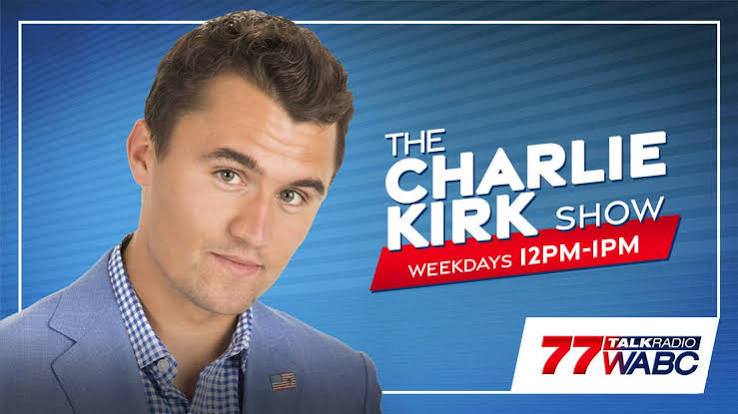
The Charlie Kirk Show became a nationally syndicated Salem Radio Network program.
Turning Point says the program ultimately aired on approximately 150 radio stations, while its podcast accumulated enormous digital consumption and the show expanded across video and streaming platforms.
That’s an important distinction.
Charlie Kirk didn’t abandon terrestrial radio when digital media became enormous.
He used all of it.
Radio.
Podcasting.
Video.
Social.
Streaming.
Live events.
Campus appearances.
One personality moving across every available distribution platform.
THAT IS MODERN RADIO WHETHER WE LIKE HIS POLITICS OR NOT
And That Is Where On The Dial Wants to Stop Talking Politics
Because this isn’t an endorsement of Charlie Kirk’s positions.
It isn’t a rejection of them either.
That’s not our lane today.
There are thousands of places on the internet where people can spend the next six hours arguing about Kirk’s politics.
Have at it.
We’ll be over here talking about the microphone.
Because radio has historically provided something a free society desperately needs.
A PLACE TO DISAGREE
Rush Limbaugh had listeners who adored him and Americans who despised him.
Howard Stern has spent decades inspiring both devotion and outrage.
Charlamagne tha God generates arguments.
Sean Hannity generates arguments.
The Breakfast Club generates arguments.
NPR generates arguments.
Sports radio can somehow generate a three hour constitutional crisis over whether the quarterback should have gone for it on fourth and two.
😂
That’s the medium.
People talk.
People disagree.
People yell at the dashboard.
People call.
People respond.
People change the station.
People turn the station back on twenty minutes later because now they’re mad and want to hear what the host says next.
THAT IS HOW IT IS SUPPOSED TO WORK
You Are Allowed to Turn the Radio Off
This may be the simplest lesson of September 10.
If somebody on the radio says something you hate
Change the station.
If a podcaster infuriates you
Unsubscribe.
If a political activist says something you believe is completely wrong
Challenge it.
Write about it.
Debate it.
Protest peacefully.
Vote.
Call the show.
Start your own podcast.
Buy a microphone.
Build your own audience.
ANSWER SPEECH WITH SPEECH
That’s the beautiful thing about a microphone.
There can always be another one.
What there cannot be in a functioning free society is the belief that disagreement gives somebody permission to eliminate the person making the argument.
That’s not left.
That’s not right.
THAT’S WRONG
Radio Knows Something About Heated Arguments
This industry has been conducting them for a century.
Radio survived arguments over war.
Civil rights.
Presidents.
Religion.
Abortion.
Guns.
Race.
Immigration.
Vietnam.
Watergate.
9 11.
Iraq.
COVID.
Trump.
Biden.
Everything imaginable.
Turn the dial across America and you’ll still find people arguing about all of it.
That’s not evidence that radio is broken.
In many ways it is evidence that the medium is doing precisely what a democratic society needs it to do.
Different frequencies.
Different voices.
Different opinions.
SAME DIAL
There’s something almost beautifully American about that.
One station says one thing.
Hit the preset.
Somebody says the opposite.
Nobody has to die.
Charlie Kirk Understood Distribution
Put politics aside and examine the media strategy.
There is a lesson here.
Kirk understood something traditional broadcasters sometimes took far too long to accept.
The radio show was not merely a radio show.
It was content.
A conversation could originate behind a microphone and become a podcast segment.
Then a video.
Then a social clip.
Then a viral moment.
Then material for a live appearance.
Then another radio discussion.
Then another clip.
Radio wasn’t competing against digital.
RADIO WAS FEEDING DIGITAL
And digital was feeding radio.
That’s the ecosystem.
Turning Point built an enormous media operation around that concept, while Kirk’s show simultaneously existed as terrestrial radio, podcasting, streaming video and social content.
Radio executives should study that architecture even if they wouldn’t spend thirty seconds listening to the politics.
Then September 10 2025 Happened
Kirk was appearing at Utah Valley University when he was assassinated.
He was 31.
The killing immediately became another deeply polarizing moment in an already deeply polarized country.
But underneath every political argument was something painfully uncomplicated.
A wife lost her husband.
Children lost their father.
Friends lost their friend.
Employees lost a colleague.
A company lost its founder.
Listeners lost a broadcaster.
And a human life ended.
There shouldn’t be anything partisan about recognizing that.
Salem Lost More Than a Syndicated Host
The relationship between Kirk and Salem explains why today’s anniversary is particularly significant to radio.
When Kirk died, Salem described him as part of its broadcasting family and emphasized the personal relationships he had developed within the company.
And the relationship didn’t simply disappear afterward.
Following his death, Kirk’s production team continued The Charlie Kirk Show. When Salem reworked its national midday lineup for 2026, Scott Jennings and Alex Marlow ultimately took over the network’s noon to 3 p.m. radio block while Kirk’s program continued as a podcast and through other distribution. Salem Media Reps also maintained a commercial relationship with the program.
That’s another fascinating broadcasting reality.
A SHOW CAN OUTLIVE ITS HOST
Not unchanged.
It can’t.
But the community built around a program can continue.
The brand can continue.
The conversations can continue.
The audience can continue.
And now one year later, the archive itself becomes programming.
The Aircheck Becomes History
Every radio person should understand this.
That ridiculous break you did Tuesday?
Save it.
The interview nobody thought mattered?
Save it.
The first show?
Save it.
The final show?
Absolutely save it.
Because broadcasters spend their careers creating a historical record without necessarily realizing they’re doing it.
Today Salem can reach into its archive and retrieve Charlie Kirk at 22 years old talking with Dennis Prager.
At the time it was radio.
Today it’s history.
That’s extraordinary.
Somewhere there is an aircheck of Rush before Rush became Rush.
Howard before Howard became Howard.
Oprah doing radio.
Letterman doing radio.
Carson doing radio.
Countless broadcasters discovering themselves behind microphones before anybody knew what those voices would eventually become.
SAVE THE AUDIO
Radio is America’s accidental audio diary.
Turning Point Did Not Disappear Either
A year after its founder’s death, Turning Point USA remains active under Erika Kirk’s leadership.
The organization continues campus activity and political organizing, and it is holding a memorial tonight at the UCCU Center on the campus of Utah Valley University where Kirk was killed one year ago.
That organization will continue to be praised by some Americans and criticized intensely by others.
That’s America.
Nobody reading On The Dial has to agree about Turning Point USA.
Nobody has to agree about Charlie Kirk.
THAT IS ACTUALLY THE POINT
The Microphone Is the Alternative to the Weapon
And maybe that’s the radio lesson worth carrying away from today.
A microphone allows one person to speak.
Another microphone allows somebody else to answer.
The telephone allows the listener to challenge them.
The internet allows millions more to respond.
The dial allows somebody to leave.
The First Amendment allows the argument to continue.
That’s civilization.
Not agreement.
ARGUMENT WITHOUT BLOODSHED
Radio at its best is built for precisely that.
We don’t need everybody saying the same thing.
God help us if they ever do.
That would be terrible radio.
😂
We need intelligent voices.
Challenging voices.
Funny voices.
Infuriating voices.
Compassionate voices.
Conservative voices.
Liberal voices.
Independent voices.
Religious voices.
Secular voices.
Local voices.
National voices.
And we need a culture mature enough to understand that hearing something we despise does not give us permission to destroy the person saying it.
One Year Later
Charlie Kirk would have had plenty to say about America today.
His supporters know that.
His critics probably know it too.
There would have been another show.
Another argument.
Another campus appearance.
Another clip.
Another controversy.
Another interview.
Another microphone.
Instead September 10 now marks the day his voice was violently removed from the conversation.
So one year later On The Dial isn’t asking anyone to adopt Charlie Kirk’s politics.
We’re asking something considerably simpler.
Remember the broadcaster.
Remember the husband and father.
Remember that disagreement is not a death sentence.
Remember that a country with hundreds of millions of people is never going to agree about everything.
And remember why radio matters in that kind of country.
Because when America is furious with itself we need places where people can still talk.
Turn on the transmitter.
Open the microphones.
Take the calls.
Make the argument.
Challenge the argument.
Get mad.
Cool off.
Come back tomorrow.
BUT KEEP TALKING
Because the moment a society decides killing is an acceptable substitute for conversation everybody loses.
Charlie Kirk had a microphone.
Millions listened.
Millions disagreed.
One year later the microphone remains.
May we always choose it.
On The Dial
#CharlieKirk #SalemMedia #SalemRadioNetwork #TurningPointUSA #TalkRadio #Radio #RadioHistory #RadioIndustry #Broadcasting #FreeSpeech #PoliticalRadio #ConservativeRadio #RadioPersonalities #TheCharlieKirkShow #OnTheDial